


For three years, Florida’s Protection of Children Act sat frozen. A federal judge blocked it in June 2023. The Supreme Court refused to unfreeze it in November 2023. A three-judge appeals panel kept it blocked in May 2025.
That protection is gone.
On Tuesday, the full 11th U.S. Circuit Court of Appeals voted 8 to 5 to vacate the injunction entirely. The law is enforceable statewide right now, while the underlying lawsuit continues in district court.
If you run an all-ages venue in Florida, book drag performers, or organize a Pride event, your legal exposure changed on Tuesday afternoon. Here is what the law actually says, what it does not say, and what the ruling leaves unsettled.
What Florida’s Protection of Children Act Actually Bans, and What It Doesn’t
The word “drag” appears nowhere in the statute.
Florida Statute 827.11 makes it a first-degree misdemeanor to “knowingly admit a child to an adult live performance.” An adult live performance means a show depicting nudity, sexual conduct, sexual excitement, specific sexual activities, lewd conduct, or “the lewd exposure of prosthetic or imitation genitals or breasts.”
Three conditions must all be met. The performance must predominantly appeal to “a prurient, shameful, or morbid interest.” It must be patently offensive to prevailing adult community standards “for the age of the child present.” And it must lack serious literary, artistic, political, or scientific value, again “for the age of the child present.”
That last phrase is doing enormous work, and it is the crux of the whole fight.
The statute also strips away the defenses you would expect. Under subsection (2), you cannot argue you did not know the child’s age. You cannot argue the child lied about their age. You cannot argue a parent consented.
A parent who brings their own kid does not violate the law. The venue that lets them in might.

Worth stating plainly, because coverage keeps blurring it: drag is a performance art, not a gender identity. Many drag performers are cisgender. Some are transgender or nonbinary. Most transgender people have never performed drag. The GLAAD Media Reference Guide is explicit on this point, and the conflation is not incidental to how these laws get sold.
How the 11th Circuit Split 8-5 and Vacated the Statewide Injunction
Judge Andrew Brasher wrote for the majority. He treated the statute as ordinary obscenity regulation rather than a speech restriction demanding heightened scrutiny.
“Preventing children from attending adult live performances obscene for them is rationally related to Florida’s interest in safeguarding the well-being of minors,” Brasher wrote. Because the act tracks the Miller obscenity test as adapted for minors, he concluded, it gets rational basis review and is presumptively constitutional.
On the vagueness question, Brasher leaned on a 1971 Florida Supreme Court definition of “lewd” to argue the term is adequately cabined. On the age-variable standard, he wrote that “it is difficult to imagine any sex-based performance that predominantly appeals to a prurient interest being suitable for a child of any age.”
He also argued the district court had no authority to issue a statewide injunction protecting non-parties, citing the Supreme Court’s 2025 decision in Trump v. CASA.
That argument did not command a majority. Judges Britt Grant and Kevin Newsom, both Trump appointees, declined to join that section. Their reasoning: once the court found the statute likely constitutional, ruling on the injunction’s scope would be an advisory opinion. Counting the five dissenters, seven of thirteen judges rejected reaching the question.
The universal injunction analysis is therefore not binding circuit law, whatever the opinion’s framing suggests.
Why Judge Rosenbaum Called the Age Standard a “Mess-Around-and-Find-Out” Statute
s
She also flagged the internal contradiction. The statute requires knowledge, then removes every knowledge-based defense. “What the Act gives with one subsection, it takes away with another,” she wrote.
Judge Abudu dissented separately on legislative history. “The act did not arise in a historical vacuum,” she wrote, pointing to lawmakers’ own statements about drag during the 2023 session.
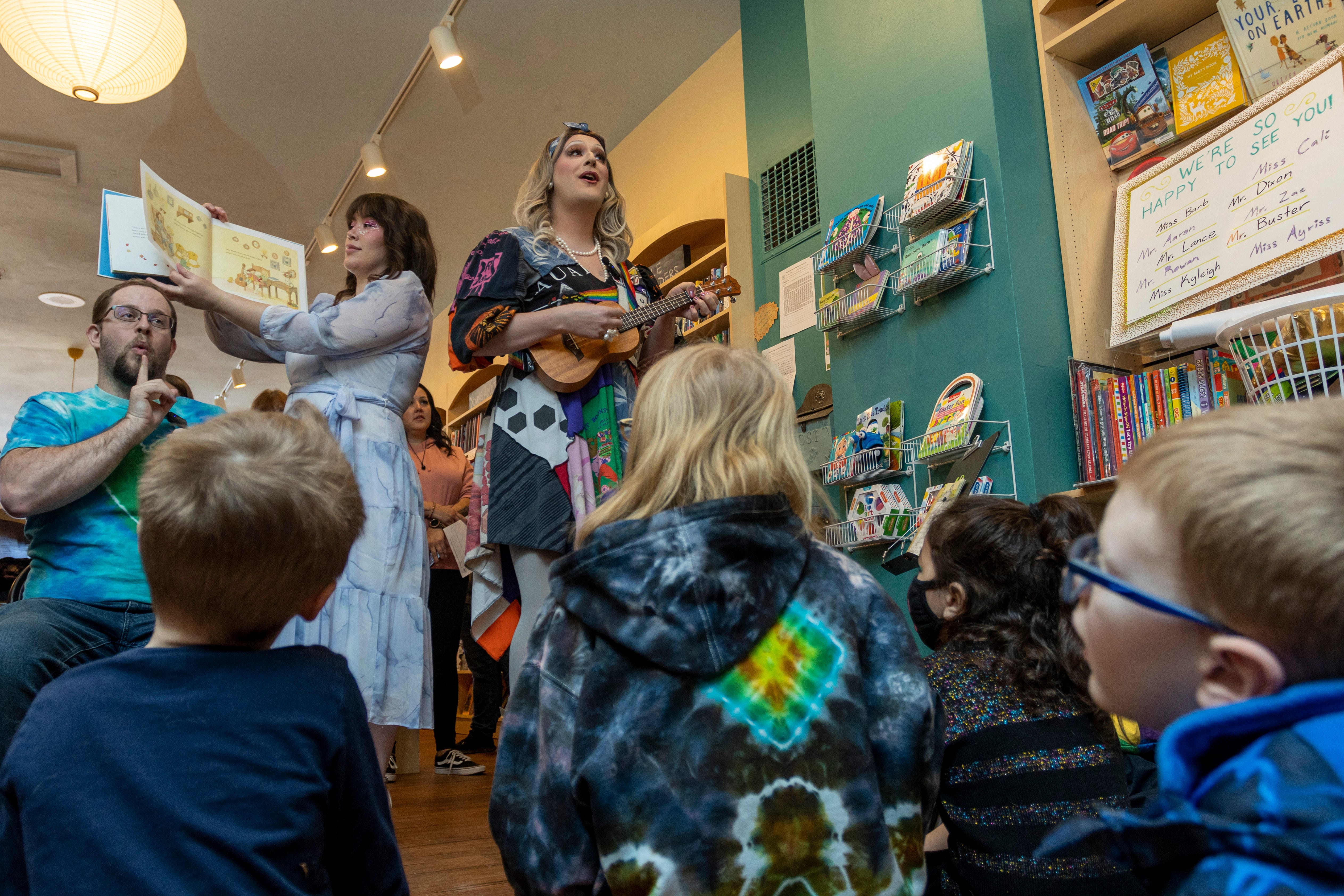
Florida Venues Now Face $5,000 Fines and Liquor License Revocation
The misdemeanor charge is not the main financial risk. The licensing penalties are.
Senate Bill 1438 amended two other statutes when it passed in 2023. Section 509.261 lets the state fine, suspend, or revoke the license of any lodging or food service establishment that admits a child to an adult live performance. Section 561.29 does the same for alcoholic beverage licenses.
The schedule: $5,000 for a first violation, $10,000 for a second or subsequent violation.
Both provisions classify a violation as “an immediate, serious danger to the public health, safety, or welfare.” That language matters procedurally. It is the standard that lets the state move to suspend a license on an emergency basis rather than waiting out a full hearing.
For a small bar in Ocala or Pensacola, an emergency liquor license suspension is not a fine. It is closure.
The exposure is not evenly distributed. A large venue with counsel on retainer can absorb an investigation. A single gay bar serving a rural county cannot. Neither can an unpaid Pride committee that books a lip sync number for a downtown block party.
James Uthmeier Already Subpoenaed a Vero Beach Wine Bar While the Law Was Blocked
The most useful evidence of how Florida will enforce this law is what the state did when it could not.
In July 2025, with the injunction still in place, Attorney General James Uthmeier issued a subpoena to The Kilted Mermaid, a Vero Beach wine bar owned by the city’s vice mayor, Linda Moore. The subject was a June 29 Pride event.
The demand was expansive. Video of the event. Camera operator logs. Employee schedules. Lists of performers and DJs. Guest lists and ticket sales records. Security documentation. Written policies and training manuals.
Uthmeier said there was evidence the event had been promoted as “all ages welcome.” He added: “In Florida, we don’t sacrifice the innocence of children for the perversions of some demented adults.”
That investigation happened under a blocked law. Uthmeier celebrated Tuesday’s ruling in a post on X, calling it a “huge victory for our team at the 11th Circuit” and writing that the full court “affirmed the constitutionality of Florida’s ban on children attending sexualized drag shows.” Governor Ron DeSantis posted that “this shouldn’t even be controversial.”
Read the state’s own description of the statute against the statute’s actual text. Officials call it a ban on children attending drag shows. The law regulates obscene-as-to-minors performances of any kind, and never mentions drag. The gap between those two descriptions is where enforcement discretion lives.
Texas and Tennessee Drag Restrictions Are Also Back in Force
Florida is not an outlier anymore. It is part of a pattern that consolidated fast.
Texas Senate Bill 12 took effect on March 18, 2026, after the 5th U.S. Circuit Court of Appeals declined rehearing. The panel there noted that most plaintiffs had not shown they intended to stage a “sexually oriented performance,” which cuts both ways: it narrows the law’s reach while leaving performers to guess where the line falls.
In Tennessee, the Supreme Court declined in 2025 to hear a challenge to the Adult Entertainment Act. The 6th U.S. Circuit Court of Appeals had ruled 2 to 1 that the Memphis theater troupe challenging the law lacked standing, never reaching the constitutional question.
Three federal circuits, three different routes, the same practical result. The facial challenge is losing as a strategy. What has not been tested is an as-applied challenge brought by a specific performer prosecuted for a specific show.
Hamburger Mary’s Returns to District Court After Losing Its Injunction
The plaintiff here is HM Florida-ORL, the operator of Hamburger Mary’s Orlando, which ran family drag shows for roughly 15 years before the law passed. It closed its downtown Orlando location in June 2025 during the litigation and has been working toward reopening in Kissimmee.
The 11th Circuit sent the case back to U.S. District Judge Gregory Presnell, who issued the original injunction. The preliminary injunction stage is over. The merits stage is not.
“This litigation is not over, and we will continue fighting to protect free speech,” said Melissa Stewart, an attorney for Hamburger Mary’s.
Three things to watch. Whether the plaintiff seeks Supreme Court review, and whether the fractured universal injunction holding gives them a hook. Whether the state brings its first enforcement action, and against whom. And whether Judge Presnell reaches a final judgment that produces a cleaner record than a preliminary injunction ever could.
The most likely near-term effect is not a prosecution. It is cancellation. Venues will pull all-ages shows, organizers will add age restrictions, and performers will lose bookings, all without a single charge being filed. Rosenbaum’s dissent argues that outcome is not a side effect of the law. It is the design.

If you run or book a Florida venue: read the statute yourself before you rely on anyone’s summary of it, including this one. Then talk to a lawyer about your specific programming. The text and the political description of the text are not the same document.
If you want to follow this: the case is HM Florida-ORL, LLC v. Secretary of the Florida Department of Business and Professional Regulation, back before Judge Presnell in the Middle District of Florida. Subscribe and we will track the first enforcement action when it comes.