


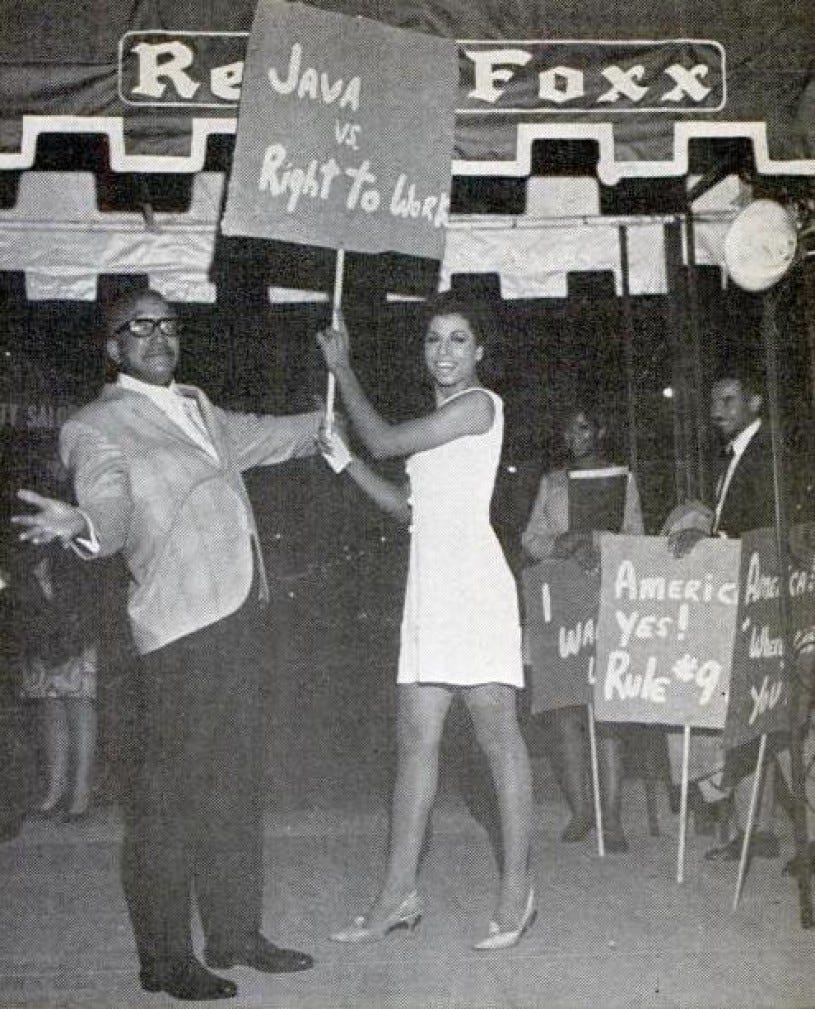
In the iconic photograph, Sir Lady Java is smiling. She has on a short white dress and a pair of pointed pumps, and she’s holding a picket sign above her head outside the Redd Foxx Club. Foxx stands to her left, one arm extended, palm up. Behind them, another sign reads “America Yes! Rule #9 No!” It could almost pass for a publicity stunt, except that the police had stopped her from doing the work she was there to promote.
Jet published the picture of the Oct. 21, 1967, protest on La Cienega Boulevard. Java’s own sign said “Java vs. Right to Work.” She wanted to get back onstage. The Los Angeles Police Department wanted her employer to understand what would happen if she did.
Under Rule No. 9, a performer needed special permission to appear in clothes associated with the “opposite sex.” Java had been billed as a female impersonator; she was also a Black trans woman who lived as a woman offstage. Police refused permission for her act. In Tennessee, nearly 60 years later, “male or female impersonators” appear in the definition of a criminal offense. In Texas, a judge has had to explain why a Dolly Parton impersonator’s breast plate should not expose a show to government interference.
Today’s laws leave room for drag, and performers in several states have won protection in court. Still, the threat to a venue’s license can put a performer out of work. A venue has a license to protect. A performer has a living to make.
Java’s protest is well documented. What came afterward deserves the same care. I wanted to understand how the rule changed, and what that change meant for performers. The court record and a contemporary newspaper report offer a more complicated ending than a clean repeal.
How Sir Lady Java Became a Los Angeles Nightclub Star
Java usually said she was born in New Orleans. Them, citing a birth record, reported that she was born in 1942 in Evangeline Parish, in rural south-central Louisiana. Hailie Sahar, the “Pose” actor who became her longtime friend, gives the date as Aug. 20, 1942, though Syracuse University’s guide to her papers says 1943. Her family moved to Riverside, California, when she was young, and her mother helped make her costumes and supported her as she came to understand her gender, according to her obituary in The New York Times.
In Los Angeles, she waited tables at the Redd Foxx Club before she ever performed there, according to the Natural History Museum of Los Angeles County. The museum credits Gertrude Gipson, a Los Angeles Sentinel columnist who also owned a nightclub, with first inviting her onstage. By the mid-1960s, Java was working rooms such as Joe’s Nairobi Lounge and the Mermaid Room with an act that mixed exotic dancing, singing, impressions and comedy. Sepia magazine called her the loveliest female impersonator in America, and Jet and Sepia covered her often.
Java was billed as a female impersonator, but she lived as a woman offstage, too. She explained it to artist Pasqual Bettio in a 2016 interview. “I dress as a female. I live as a female.”
She performed for or alongside Richard Pryor, James Brown and Sammy Davis Jr. In 1967, her shows at Le Bistro in Milwaukee inspired a local cabaret built around trans performers, according to the Wisconsin LGBTQ History Project, as LAist reported. Trevor Ladner of the One Institute in Los Angeles told LAist that female impersonation gave trans performers like Java steady work. It also gave them a place to be affirmed in their gender. Rule No. 9 put that work under police control.
The 1967 LAPD Shutdown at the Redd Foxx Club
Police warned Foxx that he could lose his license and face arrest if Java performed again. Her New York Times obituary describes the threat. Officers also emptied the club and photographed Java’s outfit, ACLU attorney Amanda Goad told LAist. An entertainer’s costume had become evidence.
Java applied for a permit. The police turned her down, Them reported, and she took her complaint outside the club. Foxx was there, but he objected to having a picket outside his business, according to LAist’s account of Jet’s coverage.
In a 2016 interview posted by her friend Tom Porter, a filmmaker, Java said she already had work and wasn’t fighting chiefly for the money. She wanted the performers who followed her to have jobs.
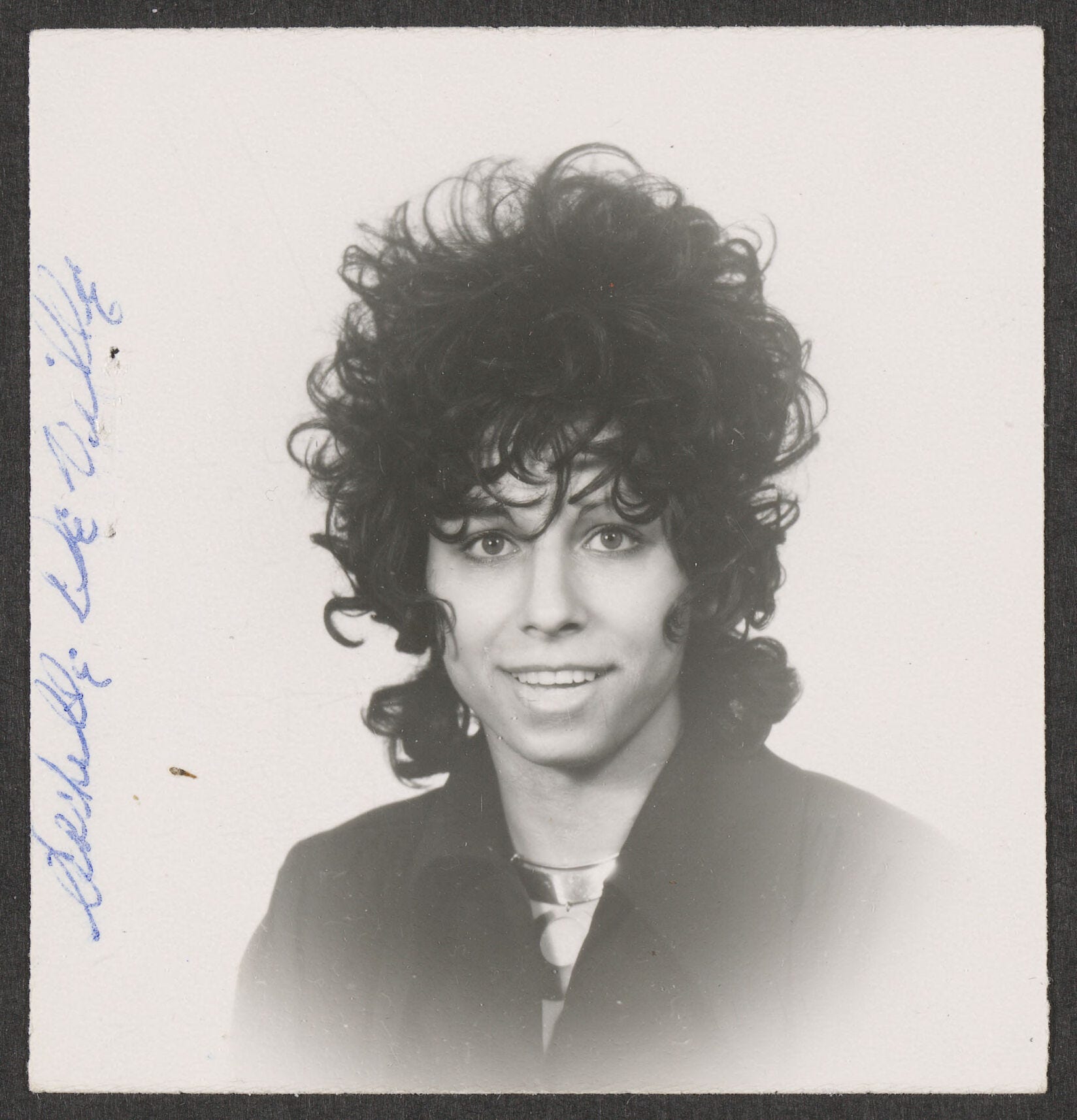
The Problem With the Three-Piece Rule Story
In the Natural History Museum’s telling, roughly 50 officers came looking for Java. She pointed to her socks, wristwatch and bow tie: three articles associated with her assigned sex, enough to keep her out of jail. That is the familiar “three-piece rule” story. The published text of Rule No. 9 contains no such requirement.
The Los Angeles Advocate printed the rule in November 1967; historian Marc Stein reproduced it in his 2019 documentary history of Stonewall. It regulates impersonation through costume or dress and makes an exception for a Police Commission permit. No garment count. Hugh Ryan, writing for History.com, found that researchers looking for a three-article statute had come up empty. The number turns up instead in later memoirs and interviews.
The rule’s wording does not tell us what officers said during a raid. Police may have used a three-piece test informally. Queer people may also have shared it as advice for avoiding arrest. Neither possibility changes the permit requirement printed in Rule No. 9.
Even the rule’s age is disputed. Goad placed its origins in the 1950s Lavender Scare; the museum calls it newly passed in 1967. Neither cites the Police Commission records needed to resolve that disagreement.
The ACLU Took Her Case. No Club Owner Joined.
Harvard and Syracuse describe Java as the ACLU’s first transgender client in their guides to her papers. The ACLU’s own historical account names her attorney: Jean Martin. Finding a club owner to join the challenge proved harder.
The ACLU account in her Times obituary says only a club owner had standing to challenge the rule. However much work Java lost, she could not bring the case on her own. The ACLU approached owners, Goad told LAist, but found none willing. Goad suggested they were worried about their relationship with the LAPD.
The owners would have had to sue the department that controlled their licenses. None joined Java, and the challenge stalled before a court could decide whether stopping her act was constitutional.
She kept picketing. The museum records rallies and coverage in Jet and the Los Angeles Advocate, and historian Susan Stryker has placed the campaign within the history of trans liberation and the broader LGBTQ rights movement.
What a 1969 Newspaper Report Adds to the Story
The Times obituary, LAist and the museum place Rule No. 9’s demise in 1969. A 2013 entry in A Gender Variance Who’s Who also dates the movie-permit ruling to that year. The court record gives a different date.
Stewart Burton managed the Vista Theater in Los Angeles. Police arrested him five times for showing films without a Police Commission permit. In Burton v. Municipal Court, the California Supreme Court ruled on June 6, 1968. The court rejected the broad standards officials used to decide who could present entertainment.
Justice Stanley Mosk wrote for a 5–2 majority. The licensing standards let officials judge applicants using “good morals” and public-welfare criteria. The court found them unconstitutional on their face. Specific health and safety requirements remained permissible.
The danger was more than hypothetical. The opinion describes officials using community complaints and judgments about taste to restrict films that were not obscene. The same permit standards also applied to theatrical performances. The court disapproved inconsistent language in Daniel, an earlier case involving food, drinks and live entertainment. A movie case had implications beyond movie theaters.
Marc Stein’s bibliography of primary sources points to Jack Foster’s February 1969 Advocate report, “Police OK Full Drag.” Foster connected the change to Burton’s case. He reported that commissioners had revised their regulations and notified bars that full drag could return. Five clubs had already changed their shows.
But Foster described a partial retreat. The commission still restricted performers’ presentation while they mingled with customers offstage, he reported. His inquiries to city officials had produced little explanation. The headline announced a victory; the account beneath it preserved the limits.
Burton also faced a standing objection. The city argued that he could not challenge the standards without first applying for a permit. The court let him proceed because the licensing scheme threatened protected expression. Java had applied and been refused, yet could not get her challenge heard without a club owner. The cases involved different parties and procedural positions. Her lost work never produced a ruling on her constitutional claim.
Together, the ruling and Foster’s report support a clearer sequence. The court ruled in 1968; the newspaper reported a policy change in early 1969. The commission’s exact amendment and effective date still need documentation. Java’s own challenge had stalled. Her pickets, rejected permit and effort to recruit a club owner remain part of how this fight unfolded.
From “The Human Tornado” to a Hollywood Pride Mural
In “The Human Tornado,” Rudy Ray Moore’s 1976 sequel to “Dolemite,” Java plays a nightclub attraction whom a rival owner wants kidnapped. Jet was still following her offscreen, covering a birthday-party meeting with Lena Horne in 1978. Java was particularly proud of her friendship with Horne.
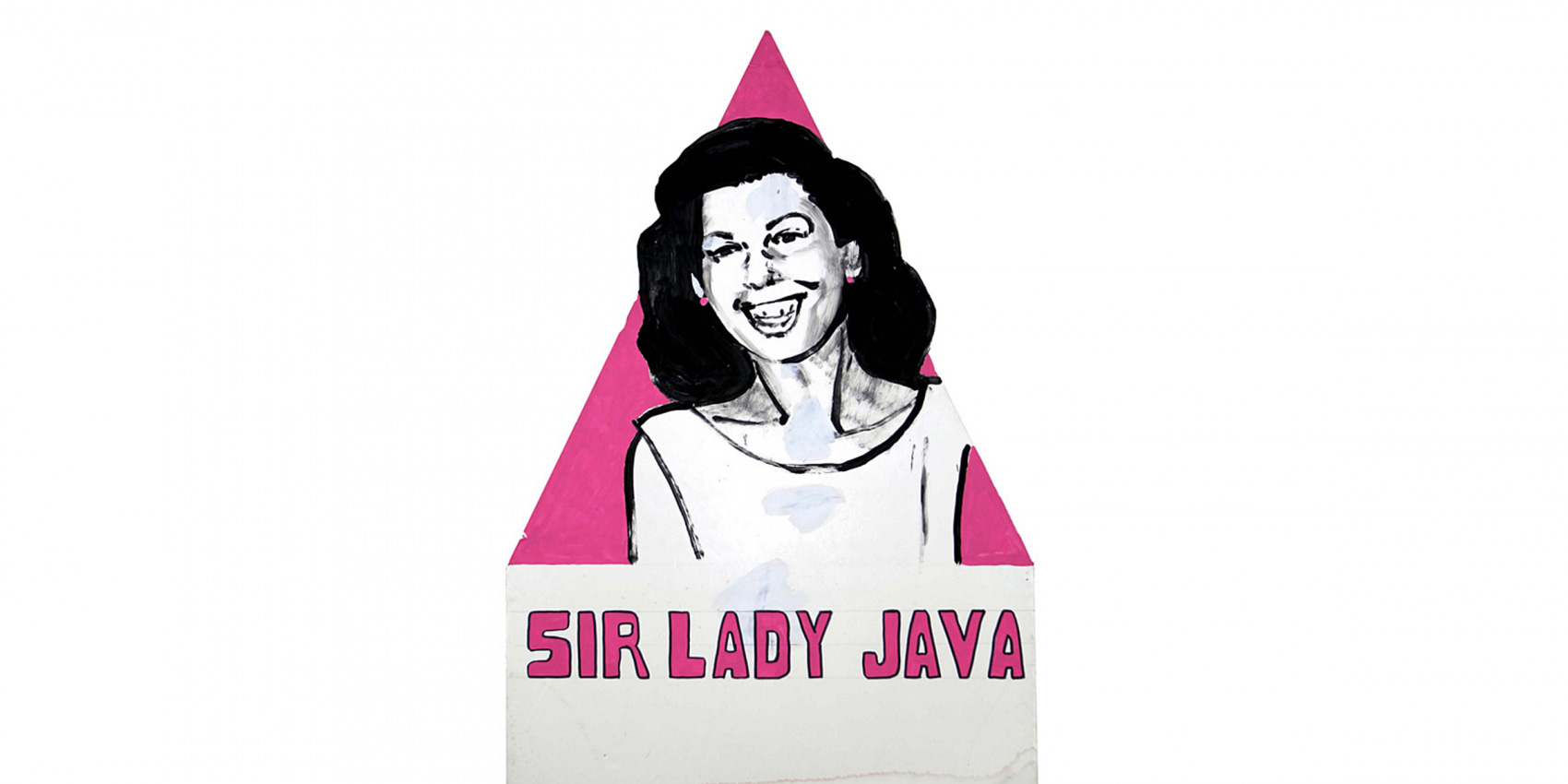
She largely withdrew from public life in the 1980s, but the queer community had not forgotten her. ACT UP members carried her portrait in a series of signs honoring local women in 1989. The Natural History Museum identifies the event as Long Beach Pride. ONE Archives at USC holds the poster: a smiling Java, painted in black and white against a pink triangle, with her name across the bottom.
Recognition returned late. She was a guest of honor at Trans Pride L.A. in 2016 and a community grand marshal of LA Pride in 2022. That September, the city unveiled a mural near Hollywood Boulevard and McCadden Place for LA Pride’s 50th anniversary. Designed by David Puck, it shows Java alongside Jewel Thais-Williams, Tim Dang, Alan Bell, Mia Yamamoto and Katrina Samala.
Java survived two strokes. She died in Los Angeles on Nov. 16, 2024, at 82 by Sahar’s count. Sahar recalled asking whether she understood how much she had done for the community. Java would pause before conceding that she had. The applause, parade invitations and public thanks had reached her while she was still alive to receive them.
Houghton Library bought a collection of Java’s material in 2018. It acquired more from Fugitive Materials in May 2025. Fugitive also published Daylon Orr’s 16-page zine “Who Is Sir Lady Java?” in 2026. Those flyers and publicity photographs preserve the working performer. They record the bookings, costumes and effort required to sell an act. They also give researchers a way to check details that differ between accounts of her life.
Tennessee Put a 1987 “Impersonators” List Into Criminal Law
When Tennessee Gov. Bill Lee signed the Adult Entertainment Act on March 2, 2023, the state did not have to invent its list of performers. It borrowed one from a 1987 statute: topless dancers, go-go dancers, exotic dancers, strippers and “male or female impersonators,” among others. The law restricts defined “adult cabaret entertainment” on public property or where minors could view it.
Being on that list is not enough to make a performance illegal; it must also be harmful to minors. We cannot assume Java’s act would have violated the law just because its descriptions resemble her billing. A first offense is a Class A misdemeanor; repeat offenses are felonies.
U.S. District Judge Thomas Parker struck down the law in June 2023. The 6th Circuit reversed him in July 2024, 2–1, because the plaintiff, Memphis theater company Friends of George’s, lacked standing. The majority read the statute to exclude performances with serious artistic value for a reasonable 17-year-old, a reading that undercut the company’s claimed threat of injury. The Supreme Court declined review in February 2025. Its refusal to take a case is not an endorsement of the law.
Blount Pride and performer Flamy Grant tried another challenge. It was dismissed for lack of standing on Oct. 24, 2025; they appealed on Nov. 21. The ACLU’s June 2026 update says the statute is enforceable while stressing that artistic drag remains legal. The echo of Java’s case is procedural. Before challenging a restriction’s constitutionality, performers may first have to establish their right to bring the case.
What Has Happened in Florida, Texas and Montana
Florida. The full 11th Circuit voted 8–5 on Aug. 4, 2026, to lift the preliminary injunction against Florida’s Protection of Children Act. Judge Andrew Brasher’s majority opinion said Hamburger Mary’s was unlikely to succeed on its constitutional claims. The statute does not use the word drag; it prohibits knowingly admitting children to “adult live performances” defined through sexual-content and age-based obscenity criteria. In dissent, Judge Robin Rosenbaum argued that the uncertainty was intended to chill drag.
The penalties include a $5,000 fine for a first violation, along with the threat of losing venue licenses. Central Florida Public Media reported in August that Hamburger Mary’s had limited its Kissimmee drag shows to adults. The restaurant is pursuing Supreme Court review. Its deadline to file is now Dec. 2, 2026: Justice Clarence Thomas granted an extension on Oct. 28, according to docket 26A601. The extension buys filing time. It does not mean the Court has agreed to hear the dispute.
Texas. Senate Bill 12 covers defined “sexually oriented performances” on public property or in front of minors. After the 5th Circuit vacated an earlier injunction, the state could begin enforcement on March 18, 2026. Two Pride groups lacked standing, the appeals court found, but other plaintiffs remained. Judge David Hittner again ruled the statute unconstitutional on Aug. 25 and barred Attorney General Ken Paxton from enforcing it. Paxton has appealed. The 5th Circuit docketed the case on Sept. 14 as 26-20525.
Hittner’s opinion brings the abstract definitions down to stage level. A Dolly Parton impersonator could dance with a breast plate; an Elvis impersonator could wear a packer and move his hips. Both examples, the judge explained, show the law reaching protected expression. Imagine having to work through that analysis while deciding what to wear for a booking.
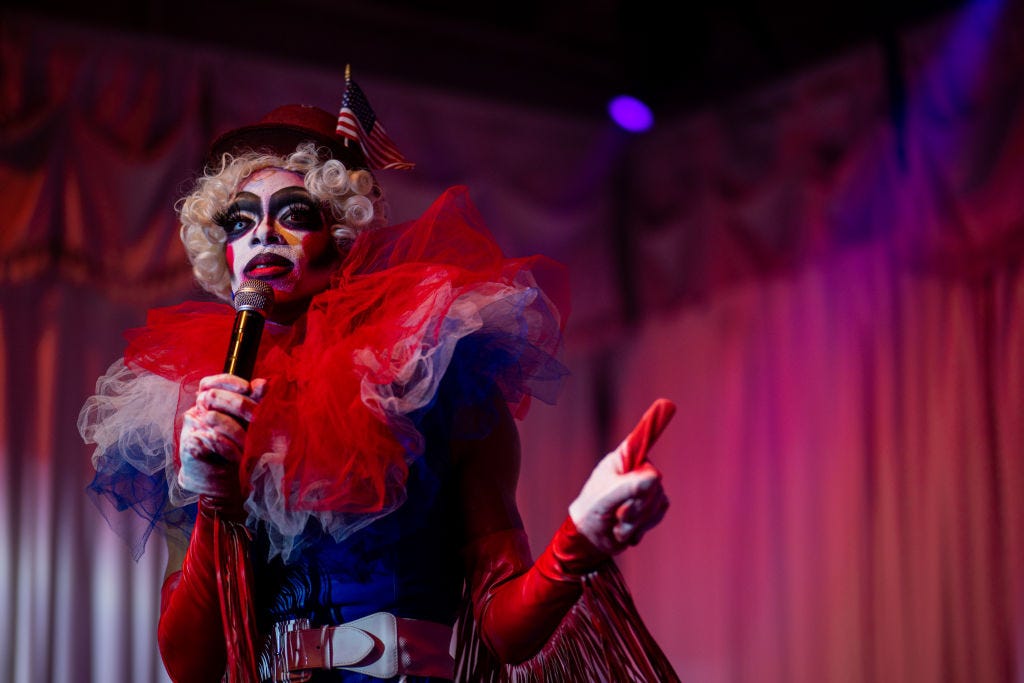
Montana. Performers and organizations there have retained protection from House Bill 359, which targets drag story hours and defined sexually oriented performances in specified public settings. On March 13, 2026, the 9th Circuit upheld a preliminary injunction. The plaintiffs, including the Imperial Sovereign Court of the State of Montana, had standing. Their injunction remains an interim measure while the litigation proceeds, rather than a final judgment disposing of the case.
Montana’s performers have an injunction. Tennessee’s challengers have struggled to get past standing. Those differences can decide whether a show goes ahead. A favorable ruling can also face another appeal. Java wanted the people who followed her to have jobs. The photograph catches her insisting on that future, sign raised, dressed for the stage.
“No one cared,” she said in an interview quoted by LAist. “So I had to care, and I kept on, kept on and kept on.”
Help fill in the record. Do you have photographs, flyers or memories of Sir Lady Java’s shows? Records of Rule No. 9 enforcement would also help. Police Commission minutes, revised rules or notices to clubs from 1968 and 1969 could clarify the change Foster reported. Reply to the email edition to reach The Queer Agenda. Please include any dates and provenance you can supply. Burton is available in Stanford Law School’s archive for readers following the court record.
Legal developments checked Nov. 2, 2026. Foster’s contemporary report links the policy change to Burton. The commission’s exact amendment and effective date remain unverified.